Chandra Manning. 6-12 Instructional Facilitator. Asheboro City Schools. NC. USA
Showing posts with label text. Show all posts

Sunday, October 26, 2014

ThinkCERCA

Last year I learned about and shared Newsela. It is AWESOME. If you have not heard about Newsela already, it is a website with current news articles that allows users to adjust Lexile levels. (Click here to read a past post on Newsela.) Now, I have discovered another source for informational texts...ThinkCERCA.

ThinkCERCA is an online, CCSS-aligned literacy program for students in grades 4-12 (with parent consent) with content and tools to help students read closely, think critically, and write sound arguments. It is free to join and access basic functions, but there are additional tools available through a paid subscription. CERCA (in the title) actually stands for Claim, Evidence, Reasoning, Counter-argument, and Audience. When students complete full lessons they are both reading and writing-- "Common Core style". There are some really cool features to explore:

  • An audio feature reads each article aloud to students. 
  • Teachers have the option to input constructed response questions.
  • ThinkCERCA has an embedded dictionary within each article.
Take look through the website and see how you can use it to increase access for your students.


Explore ThinkCERCA from ThinkCERCA on Vimeo.

Friday, July 12, 2013

Online Text

I just spent a week with a group of hardworking Asheboro City Schools teachers who helped to find free, online text resources for English Language Arts teachers.  In the fall, we will roll out a site with links to fiction and nonfiction exemplar texts, as well as readings represented in local and published unit plans.  A good portion of our work was around evaluating text complexity, as well.  Here is a great video that explains the three considerations in evaluating text complexity:  quantitative measures, qualitative measures, and reader & task.


Introduction to Text Complexity from NYC DOE Promising Pract on Vimeo.

I also have a LiveBinder with links to sites that provided easy access to many of our text selections:

Free Online Text

Thanks to Meredith Wolfe (NAMS), Julia Dawson (SAMS), Brenda Kern (AHS), and Kathy Saunders (AHS) for all their work!

~Chandra

Monday, December 17, 2012

Vocabulary Tied to Text

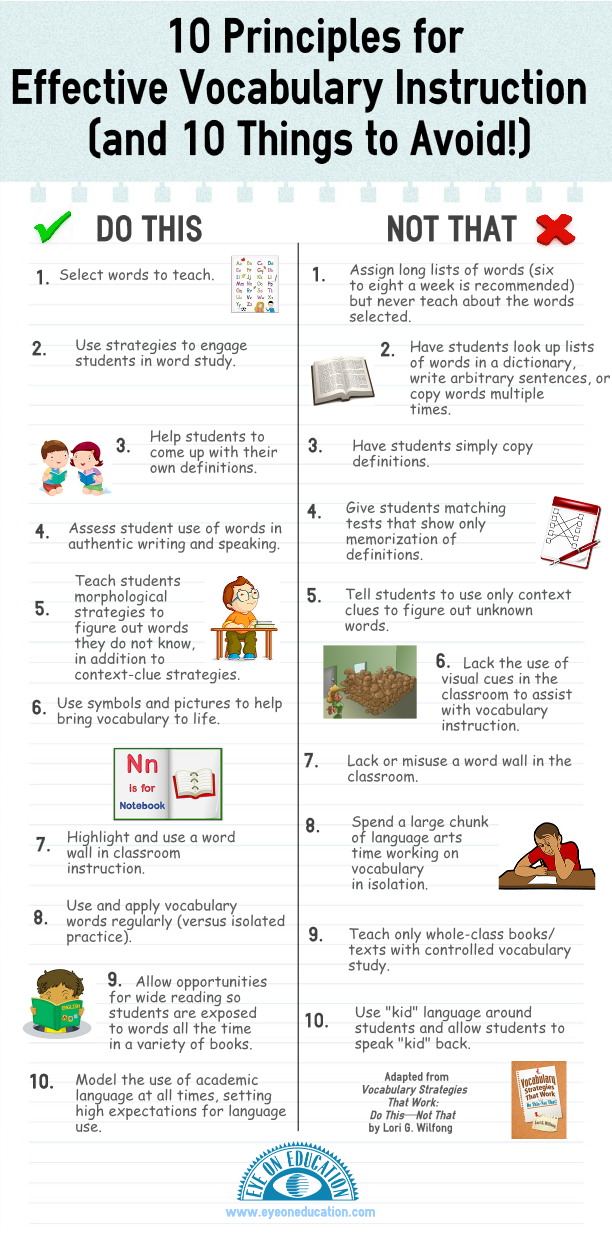
Julie Pack, Director of Secondary Education for ACS, sent me the article below from The Forum's The Friday Report.  Please read it as it provides additional evidence for why vocabulary should not be taught in isolation.  I also added an infographic on 10 Principles for Effective Vocabulary Instruction from Eye on Education.
________________________________________________________


NAEP Data on Vocabulary Shows Achievement Gap and Emphasizes Relation to Reading Comprehension
    
    The recently released National Assessment of Educational Progress report found further evidence to back research that vocabulary knowledge is important to text comprehension. In 2011, 4th and 8th graders performing above the 75th percentile in reading comprehension on NAEP had the highest average vocabulary scores. Likewise, those 4th and 8th graders scoring at or below the 25th percentile had the lowest average vocabulary scores.

    The NAEP report also revealed stark achievement gaps in vocabulary across racial and ethnic groups, as well as income levels. The achievement gap shown in vocabulary follows trends of the gap shown in other reported assessments of the NAEP. In 4th grade, there was a 31 point gap in vocabulary on a 0-500 scale between students who are eligible for free or reduced lunch and those who are not. In 8th grade, the gap was 28 points.

    Previous NAEP assessments have included some vocabulary questions, but the revised framework for reading set new criteria for developing vocabulary questions and increasing their number in order to allow the test to measure students' vocabulary performance and report it as a separate item.

    Words selected for inclusion in vocabulary test questions were specifically selected to be characteristic of written language (as opposed to everyday speech), used in a variety of content areas, generally familiar concepts, feelings, or action, and necessary for understanding part or all of the passage in which they appeared in the test. For fourth graders, words such as "barren," "Detected," and "eerie" were problematic, with fewer than half of students identifying their meaning correctly. "Urbane" showed the same results for 8th and 12th grade students. North Carolina students scored in line with the national average on vocabulary scores. (Erik Robelen, "NAEP Data on Vocabulary Achievement Show Same Gaps," EDUCATION WEEK, 11/6/12)


Article source:
The Forum:  Public School Forum of North Carolina.  The Friday Report.  15.23 (14 Dec 2012).  Online.