Here is a Smore that contains lots of literacy resources, courtesy of Carla Shinn, Media Specialist at AHS. Enjoy!
Friday, September 6, 2013

Thursday, September 5, 2013
The F Word
Hopefully my title got your attention.
The F word I'm referring to is not something you'll see etched in a bathroom stall. It's FAILURE.
I just read an online article on Edutopia called "Making Friends with Failure" by Ainissa Ramirez. In the article, Ramirez says, "Failure makes you a better, stronger, and wiser human being." I think you should take some time and read the full article to learn the author's thoughts on encouraging our students to take academic risks in order for them to become better students. Ramirez is a proponent of STEM (Science, Technology, Engineering, and Math) focused tasks to help in that process.

The F word I'm referring to is not something you'll see etched in a bathroom stall. It's FAILURE.
I just read an online article on Edutopia called "Making Friends with Failure" by Ainissa Ramirez. In the article, Ramirez says, "Failure makes you a better, stronger, and wiser human being." I think you should take some time and read the full article to learn the author's thoughts on encouraging our students to take academic risks in order for them to become better students. Ramirez is a proponent of STEM (Science, Technology, Engineering, and Math) focused tasks to help in that process.

Wednesday, September 4, 2013
Graphic Organizers
Graphic organizers help to make abstract ideas and relationships clear.

Be sure there is an intended purpose for the graphic organizer you provide AND that the students understand that they will be using the completed organizer for a specific purpose.
- Graphic organizers show students how to think about the information they are learning.
- They make new information manageable by enabling students to chunk it to fit into their existing memory.
- They help students build connections and explore relationships to what they already know.
- Organizers also help students recall information more readily.
There are so many ways they can be used...here are just a few: structure the note taking; generate ideas; record key text information; guide reading; select, sequence, restructure, and store information; organize ideas as a pre-writing tool; focus on what is important; and summarize learning.
Hover your cursor over the the small circles within my Graphic Organizer ThingLink to discover many resources you can use.

Be sure there is an intended purpose for the graphic organizer you provide AND that the students understand that they will be using the completed organizer for a specific purpose.
Friday, August 30, 2013
When the cook tastes the soup...
 "When the cook tastes the soup, that's formative. When the guests taste the soup, that's summative."

That quote is the best way to remember the definition and importance of formative assessment. My last post gave some ideas for pre-assessing students, which is a form of formative assessment. Here are some links to help you with formative assessment during a unit:
- "What Are Formative Assessments and Why Should We Use Them" (from Scholastic)
- Formative Assessment Activities (LearnNC)
- Formative Assessment Tools and Strategies for the 21st Century (from Idaho State Department of Education)
And don't forget about NC FALCON (North Carolina's Formative Assessment Learning Community's Online Network), accessible through your NC Education Moodle account.
Tuesday, August 27, 2013
Where Do I Begin?
"Assessment is today's means of modifying tomorrow's instruction."
~Carol Ann Tomlinson
- to make instructional decisions about student strengths and needs
- to determine flexible grouping patterns
- to determine which students are ready for advance instruction

Carousel Brainstorm - Chart papers containing statements or issues for student consideration are posted around the classroom. Groups of students brainstorm at one station and then rotate to the next position where they add additional comments. When the carousel "stops", the original team prepares a summary and then presents the large group's findings. A Carousel Brainstorm is an active, student-centered method to generate data about a group's collective prior knowledge of a variety of issues associated with a single topic.
Yes/No Cards - Students make a card with YES on one side, NO on the opposite side. Teachers ask an introductory (or review) question. Students who know the answer hold up the YES card; if they don't know they answer they hold the NO card. This is an effective strategy to use when introducing vocabulary words/phrases.
Think-Ink-Pair-Share - A way to get students to reveal what they know or believe about a topic is to begin by having them commit their thoughts to writing. To assess what the group knows, have students discuss their ideas in pairs, and then to share them with the large group.
Other Examples of Pre-Assessment Strategies:
- Questioning (consider using Costa's Levels of Questioning-an AVID strategy)
- Predictions
- Entrance or exit cards
- Interest surveys
- KWL charts
- Graphic organizers
- Student Interviews
- Self-evaluations
- Teacher observations/checklists
- Anticipation guides or journals
- Game activities
- Concept maps
- Writing prompts and samples
- Teacher prepared pre-assessments
- Picture interpretation
Also check out:
"6 Traits of Quality Pre-assessments" (Byrdseed): http://www.byrdseed.com/six-traits-of-quality-pre-assessments/
Source:
NCDPI ELA Team (K-12)
Monday, August 12, 2013
ExC-ELL
Have you ever heard of ExC-ELL? Is your first thought of spreadsheets? Well, that is Microsoft's Excel. ExC-ELL stands for Expediting Comprehension for English Language Learners. It is a research-based literacy model developed by Dr. Margarita Calderon that is funded by the Carnegie Corporation and the US Department of Education. I, along with Dubraska Stines (ESL Lead Teacher) and almost 20 other ACS teachers, attended ExC-ELL training, sponsored by NCDPI, in Charlotte, NC, August 5-7. All of the teachers were charged with coming back to our district to share ExC-ELL strategies which help students access the text with the use of vocabulary, reading, and writing tasks. Although ExC-ELL was designed to help English Language Learners, the work can help any student to improve their reading in various content disciplines.

We have a great team of teachers who are willing to share. We hope to be able to snag some dedicated PD time during the year, but if you have a particular interest and would like to start the year off with new learning, contact a team member. Matt Edwards and Chandra Collins, both from NAMS, implemented it in their classes last year and have completed advanced training. They are great contacts! (Check us out presenting during the closing session on Day 3.)

Chandra M., Dubraska, and Betsy
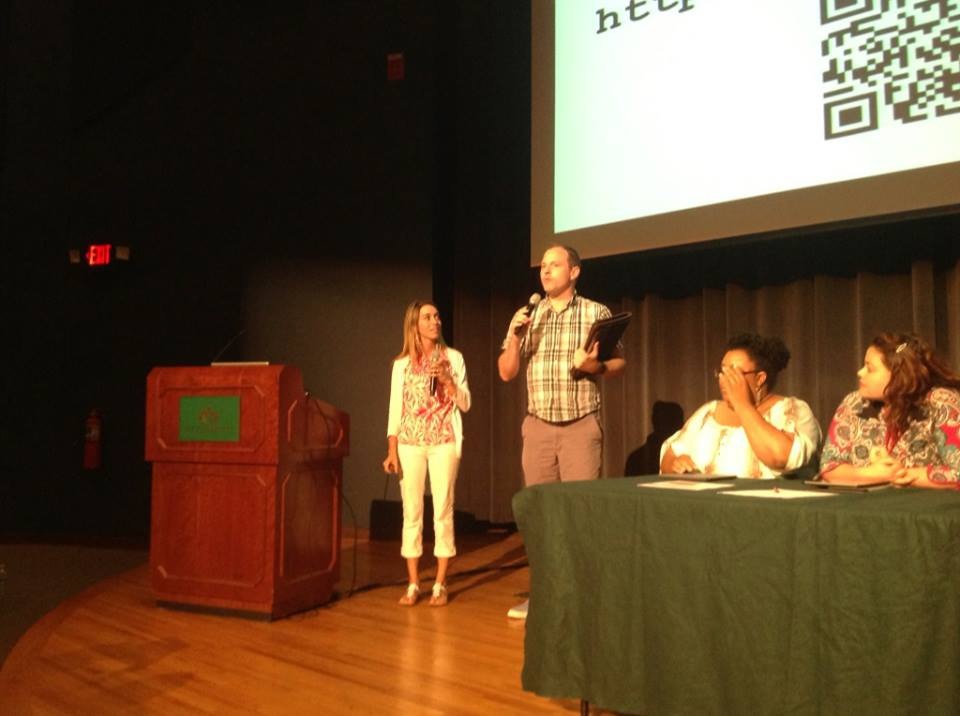
Chandra C., Matt, Chandra M. and Dubraska
Friday, July 12, 2013
Online Text
I just spent a week with a group of hardworking Asheboro City Schools teachers who helped to find free, online text resources for English Language Arts teachers. In the fall, we will roll out a site with links to fiction and nonfiction exemplar texts, as well as readings represented in local and published unit plans. A good portion of our work was around evaluating text complexity, as well. Here is a great video that explains the three considerations in evaluating text complexity: quantitative measures, qualitative measures, and reader & task.
Introduction to Text Complexity from NYC DOE Promising Pract on Vimeo.
I also have a LiveBinder with links to sites that provided easy access to many of our text selections:

Introduction to Text Complexity from NYC DOE Promising Pract on Vimeo.
I also have a LiveBinder with links to sites that provided easy access to many of our text selections:
Free Online Text
Thanks to Meredith Wolfe (NAMS), Julia Dawson (SAMS), Brenda Kern (AHS), and Kathy Saunders (AHS) for all their work!
~Chandra
Thanks to Meredith Wolfe (NAMS), Julia Dawson (SAMS), Brenda Kern (AHS), and Kathy Saunders (AHS) for all their work!
~Chandra
Subscribe to:
Posts (Atom)